

How to Get Personalized Skincare Recommendations
Table of Contents
- What You'll Need Before You Start
- How to Identify Your Skin Type and Concerns
- How Online Skin Analysis Quizzes Work (And When They Fail)
- Finding the Best Skincare Quiz for Skin Type
- How to Build a Skincare Routine from Scratch
- What a Dermatologist Recommended Skincare Routine Actually Looks Like
- Cost, Privacy, and What Most Guides Skip
- Common Mistakes That Derail Personalized Skincare
- Frequently Asked Questions
Last Updated: September 16, 2026
What You'll Need Before You Start
Getting personalized skincare recommendations starts with gathering the right information about your own skin before you buy anything. This guide from J5 Beauty & Skincare walks through the process, from identifying your skin type to choosing a regimen builder that fits your budget and lifestyle.
Most people skip this step and jump straight to products. That's why so many routines fail.
Here's what to have ready before you begin:
- A bare face, washed with a gentle cleanser and patted dry
- Good natural lighting and a mirror
- Notes on how your skin behaves across a full day, not just after washing
- A list of products you currently use, including anything that caused irritation
- Your budget range and how much time you'll realistically spend on a routine
Personalized skincare matches products and ingredients to your skin type, concerns, and environment rather than a generic routine. The difference shows up in how your skin barrier responds.
How to Identify Your Skin Type and Concerns
The fastest way to identify your skin type is the bare-face test: cleanse, wait one hour, then press a blotting sheet across your forehead, cheeks, and chin. Oil on all three zones means oily; oil only on the T-zone means combination; no oil with tightness means dry.
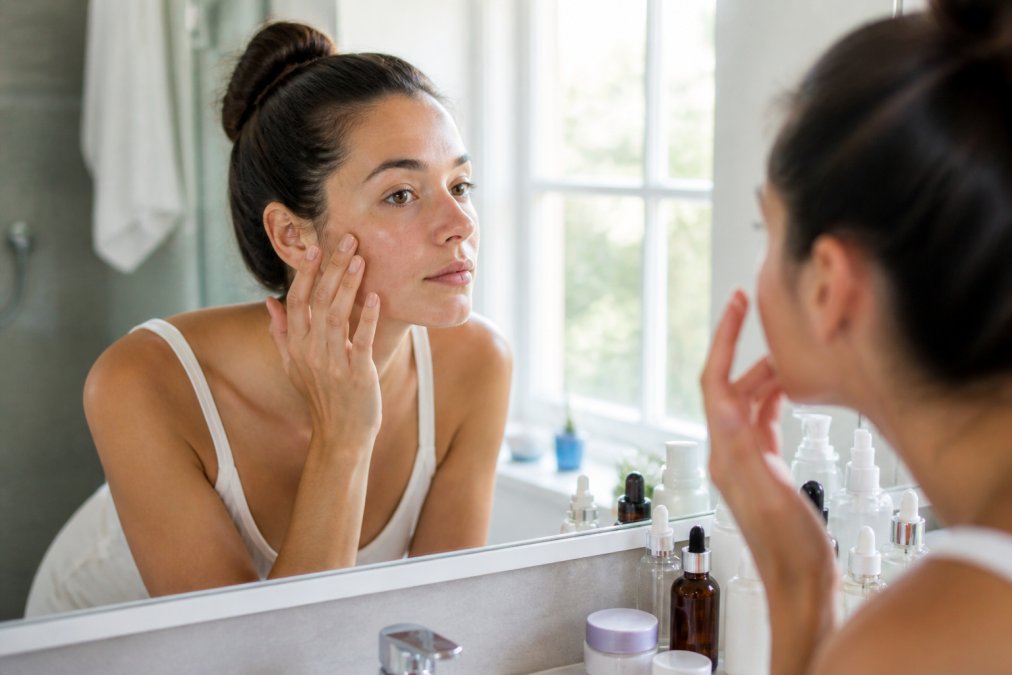
Skin concerns sit separately from skin type.
The Five Questions That Narrow Everything Down
- How does your skin feel one hour after cleansing, without product?
- Where do you break out, and does it change with your cycle or stress levels?
- Does your skin sting or turn red when you apply active ingredients?
- How much sun exposure do you get in a typical week?
- What does your skin look like by 4 p.m. compared to 9 a.m.?
Your answers map to formulation types: stinging and redness suggest a compromised barrier needing gentler actives, midday shine with morning tightness points to dehydration rather than true oiliness, and jawline breakouts often track with hormonal shifts.
How Online Skin Analysis Quizzes Work (And When They Fail)
Online skin analysis quizzes combine your answers with image recognition or a rule-based algorithm to suggest products. They narrow a wide field well, but fail when they rely on a single selfie, ignore lifestyle factors, or push a fixed product line regardless of your answers.
Where they break down:
- Lighting and camera quality. Warm indoor light shifts how AI-driven diagnostics classify tone and redness.
- Brand-owned quizzes. A quiz built to sell one product line will find a way to recommend that line. The decision tree is designed around inventory, not your skin.
- No follow-up. Skin changes with seasons, stress, and medication, so a one-time result goes stale fast. A quiz you took in January may be wrong by July.
- No explanation layer. If the tool can't tell you why it recommended a product, you can't evaluate whether the reasoning applies to you.
Finding the Best Skincare Quiz for Skin Type
The best skincare quiz for skin type asks about lifestyle, environment, and past reactions, then explains why each recommended product fits. If it can't give you the reasoning, it isn't personalizing anything.
Look for these markers:
- Questions about climate, humidity, and seasonal changes
- A clear explanation of each recommended active ingredient and its purpose
- Options for sensitive, acne-prone, and combination skin rather than three broad categories
- No requirement to buy before seeing results
How to Build a Skincare Routine from Scratch
Building a routine from scratch follows a fixed order: cleanse, treat, moisturize, protect. Start with the fewest products that address your primary concern, then add steps only when your skin has adjusted.
What You'll Need
Clinique Hydration Heroes Gift Set →
- A gentle cleanser suited to your skin type
- One treatment product for your main concern
- A moisturizer
- A broad-spectrum sunscreen
| Step | Product Type | Frequency | Primary Purpose |
|---|---|---|---|
| Cleanse | Gentle cleanser | Twice daily | Remove buildup |
| Treat | Active serum | Once daily to start | Target concern |
| Moisturize | Lightweight cream | Twice daily | Support barrier |
| Protect | Broad-spectrum SPF | Every morning | Prevent damage |
What a Dermatologist Recommended Skincare Routine Actually Looks Like
A dermatologist recommended skincare routine is built around proven actives and consistency, not product count. Most dermatologists start patients on three or four products and adjust based on how skin responds over eight to twelve weeks.
The core structure rarely changes:
- A mild, non-comedogenic cleanser
- A single targeted active, such as a retinoid or an exfoliating acid
- A moisturizer matched to skin hydration levels
- Daily sun protection
Cost, Privacy, and What Most Guides Skip
Cost and data privacy are the two factors most skincare guides ignore, and both should shape which route you take. Professional consultations carry a per-visit fee, while app-based tools are often free but collect photos and skin data that may be shared with third parties.
The Real Cost Comparison
On cost, the math depends on how many products you'd otherwise buy and discard. A consultation gives you a clinical opinion, but you pay for each follow-up. A quiz is free or cheap, but you may spend more testing products that don't fit. Many people find a hybrid works best: use a quiz to shortlist, then buy travel sizes to test before committing.
What to Check Before You Upload a Photo
On privacy, check what an app does with your photos. Look for a clear privacy policy, a data-deletion option, and a statement about whether images train models. If none of that is stated, assume your photos aren't private.
A practical checklist before you upload:
- Is there a privacy policy linked on the quiz page itself? If you have to hunt for it, that's a signal.
- Does the policy state how long images are retained? "Indefinitely" or silence on retention are both red flags.
- Is there a delete-my-data option in the account settings? If deletion requires an email to support, the process is designed to be inconvenient.
- Are images used to train models? Some tools use your photo to improve their algorithm. That may be fine, but you should know.
- Is the data shared with third parties? Look for language about "partners" or "affiliates."
Sustainability and Ingredient Compatibility
Ingredient compatibility goes beyond what your skin tolerates. Layering incompatible actives, such as certain acids with retinoids, can irritate skin and waste product. Patch testing on your inner forearm before full application prevents most of that waste.
Common Mistakes That Derail Personalized Skincare
The most common mistake is changing too many products at once. When four things change and your skin reacts, you have no way to identify the cause.
Other frequent errors:
- Skipping patch testing. Apply a small amount to your inner forearm and wait 24 hours before using it on your face.
- Chasing trends over your skin type. A product that transformed someone else's complexion may be wrong for yours.
- Ignoring seasonal shifts. Skin hydration levels drop in winter and sebum production rises in summer. Your routine should shift with them.
- Over-exfoliating. Daily acid use damages the skin barrier. Most people do better with two or three sessions per week.
- Buying full sizes first. Travel and discovery sizes let you test compatibility before committing.
Frequently Asked Questions
Do I need a dermatologist to get personalized skincare recommendations?
Not always. A dermatologist is essential for diagnosing conditions like rosacea, cystic acne, or eczema. For general routine building, a well-designed skin analysis quiz combined with patch testing can narrow your options effectively. If you have persistent irritation or a condition that hasn't improved with over-the-counter products, a dermatological assessment is worth the cost. Many people use quizzes to build a baseline routine, then bring that routine to a dermatologist for refinement.
Are online skincare quizzes accurate for personalized recommendations?
Accuracy varies widely. Quizzes from dermatologist-founded brands tend to ask about skin sensitivity, sebum production, and lifestyle factors, which improves results. Brand-owned quizzes on retailer sites may steer toward their own catalog. A quiz works best as a starting filter, not a final answer. Patch test any new active ingredients and give a new routine four to six weeks before judging results. If a quiz recommends six products at once, introduce them one at a time.
How can I create a personalized skincare routine on a budget?
Start with three products: a gentle cleanser, a moisturizer suited to your skin type, and a sunscreen. Add one active ingredient, such as niacinamide or salicylic acid, only after the basics feel comfortable. Travel-size kits let you test formulas before committing to full sizes. The Madagascar Centella Pore-Minimizing Travel Kit at $37.43 covers four steps for oily and combination skin, and the Dermalogica Healthy Skin Discovery Kit at $51.16 works for all skin types.
What is the 4-2-4 rule in skincare?
The 4-2-4 rule is a timing guideline: cleanse for four minutes total (including oil cleanse and water-based cleanse), apply treatments for two minutes, and moisturize plus SPF for four minutes. It is not a clinical standard but a pacing method to ensure each step absorbs before the next. Rushing through serum layering reduces how well active ingredients penetrate. If you use prescription topicals, follow your dermatologist's instructions over any social media rule.